


June 2026: Engine control MV Agusta - Supermotors!
To eliminate the weaknesses of the purely mechanical systems (e.g. limited switch life and physical limit to high engine speeds), Electronic Ignition (EI) systems started to be used on cars in the early 70s. The first to use EI on cars were Fiat and Chrysler with switchless systems in 1970-71. These systems have since been continuously developed into today's integrated systems that, in addition to ignition and injection, also include functionality for various safety systems such as ABS, TCS, ESC and Launch Control.
The following summary of MV Agusta's development shows how the various engine management systems on motorcycles have evolved:
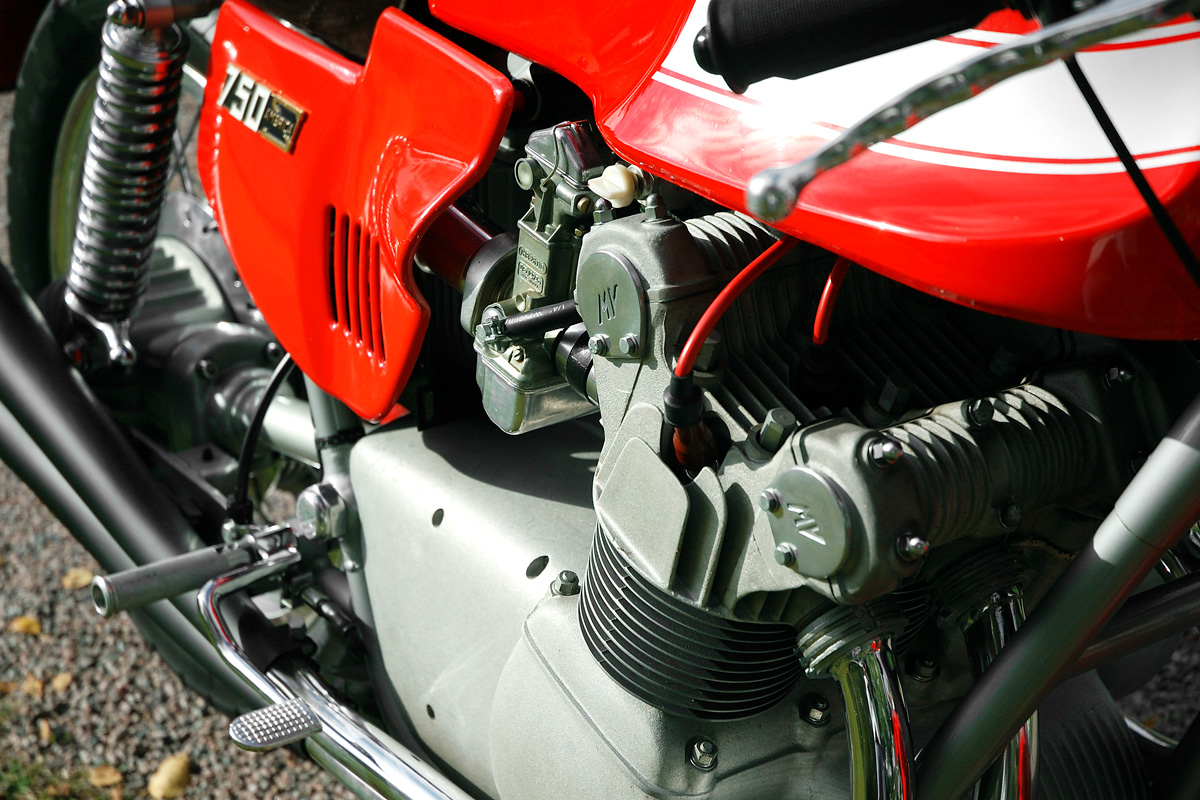
750 Sport America, 1977; fully mechanical ignition via distributor with switch and conventional carburetor with fixed nozzles for the fuel-air mixture.
F4 750, 1999; integrated electronic ignition/fuel mixture (Magneti-Marrelli) where a handful of sensors (e.g. crankshaft and throttle position, coolant temperature and intake air pressure) are managed in a separate computer ECU (Electronic Control Unit) to optimize engine operation. The setting of ignition and fuel mixture data at different engine speeds is permanently programmed; to change the data, one PROM (memory capsule) can be exchanged for another. The idle speed and the initial fuel mixture value (CO content) can be adjusted mechanically.
F4 1000 R, 2007; the electronic ignition/fuel mixture system (Magneti-Marrelli) was updated to meet the new exhaust emission standards (Euro3) including active catalyst with lambda probe and crankcase ventilation system. At the same time, the possibilities for programmable adjustment of idle and fuel mixture were also updated, as well as significantly expanded possibilities for diagnostics with an externally connected instrument (PC with software that communicates with the ECU via cable or wirelessly via Bluetooth). However, to change ignition/fuel mixture characteristics (e.g. when changing to a more open exhaust system/air filter), the entire ECU must be changed.
F4 1000 R, 2010; another update of the system from Magneti-Marelli for handling variable intake funnels, handling two different fixed so-called engine maps (mode Sport and Normal) and two-mode TCS.
F4 1000 RR, 2013; brand new engine control system from Eldor, MVICS (Motor & Vehicle Integrated Control System). The Eldor system now handles input from some 30 different sensors which, in addition to controlling the ignition/fuel mixture, are also used in an integrated way to control the various safety functions such as ABS, traction control (RLM) and traction control (TCS, eight different stages). The ABS system has two different operating modes, Normal or Race, and can also be switched off completely. The system also provides clutchless upshift and downshift functions (e.g. intermediate throttle) via an Electronically Assisted Shift (EAS) system and anti-wheeling. Coupling between injection and throttle is done electrically via Ride-By-Wire stepper motors. The engine character can be selected in four different modes (folders), three fixed and one programmable by the driver. The different modes (Normal, Sport and Rain) provide different power, torque, maximum speed, engine braking, engine response and throttle sensitivity. In the programmable mode (Custom) these parameters can be selected individually. The suspension system (Öhlins) is also electrically controlled, i.e. you can change the characteristics of the front fork suspension, steering damper and rear damper via button control.
The diagnostic options for servicing have also been significantly expanded. The biggest change, however, is the possibility to update the entire ECU software, i.e. both the software for the basic functions and the software (the so-called folders) for ignition/fuel mixture properties. This means that the whole engine characterization can be changed and updated continuously as customer experience and factory test driver experience develops. This is precisely what was questioned, quite wrongly in fact, when MV launched the first 3-cylinder model in 2012, the F3 675. They had chosen to have a lot of "race" character on the engine (i.e. slightly worse low-speed characteristics), which perhaps not all customers appreciated. Since then, new folders have now arrived that completely eliminate these problems.
After the work has been carried out, you will always receive a detailed service report where the points carried out are marked and where any deviations are noted.
NOTE! You now also get an exclusive MV Agusta Garage Carpet at no extra cost!
Description